
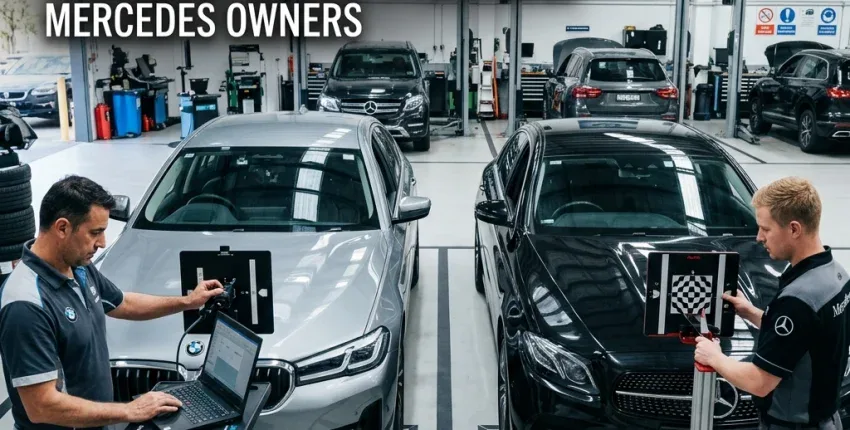
You didn’t buy a BMW or a Mercedes-Benz just for the badge. You bought it for the precision engineering, the effortless power, and, perhaps most importantly, the cutting-edge safety technology. Whether it’s the Active Driving Assistant in your X5 or the Distronic Plus system in your S-Class, your vehicle is essentially a high-performance computer on wheels.
But what happens when that computer loses its sense of direction?
There is a common scenario we see at The Auto Lounge: a client has a windshield replaced or upgrades their suspension, and because there are no warning lights on the dashboard, they assume everything is perfectly fine. Unfortunately, this is one of the most dangerous assumptions a luxury car owner can make.
In this guide, we’re going to look at the truth behind Advanced Driver Assistance Systems (ADAS) calibration. We will explore why it isn’t just a “recommended” service, but a mandatory requirement for maintaining the safety and integrity of your European performance vehicle.
What Exactly is ADAS?
Before we dive into why calibration is necessary, we need to understand what we are calibrating. ADAS is an umbrella term for the electronic systems that help the driver with various functions. These include:
- Adaptive Cruise Control: Maintaining a set distance from the car in front.
- Lane Keeping Assist: Using cameras to identify lane markers and nudging the steering if you drift.
- Automatic Emergency Braking (AEB): Detecting an imminent collision and applying the brakes.
- Blind Spot Detection: Using radar to see where your mirrors cannot.
- Pedestrian Detection: Identifying human shapes in your path to prevent accidents.
These systems rely on a sophisticated network of cameras (usually mounted behind the rearview mirror), radar sensors (located in the grille or bumpers), and ultrasonic sensors. For these to work, they must be aimed with mathematical precision.

The Invisible Threat: Why Precision Matters
Imagine you are aiming a laser pointer at a target ten feet away. If your hand shakes by just a millimeter, the dot moves slightly. Now, imagine that target is 300 feet away. That same one-millimeter shift at the source might cause the laser to miss the target by several feet.
This is exactly how ADAS works. Your BMW’s front-facing camera and Mercedes’ radar sensors are designed to “see” hundreds of feet down the road. If a sensor is misaligned by even a fraction of a degree: something completely invisible to the naked eye: the car’s “vision” could be off by a massive margin at highway speeds.
The result? Your car might think the car in the next lane is directly in front of you, causing a sudden, ghost-braking event. Or worse, it might fail to detect a stopped vehicle in your actual path until it’s too late.
When Is Calibration Absolutely Required?
Many owners believe that calibration is only necessary after a major accident. While collision repair definitely requires it, there are several “routine” services that also trigger the need for a recalibration.
1. Windshield Replacement
This is the most common reason for ADAS calibration. In most modern BMWs and Mercedes, the forward-facing camera is mounted directly to the inside of the windshield. Even if you use OEM glass, the slight variation in the thickness of the glass or the exact mounting position of the camera bracket means the camera’s “field of view” has changed.
2. Suspension Work and Tuning
At The Auto Lounge, we specialize in suspension tuning. However, any time you change the ride height of your vehicle: whether it’s through lowering springs, coilovers, or even just replacing worn-out struts: the angle of the car changes. If the front of the car sits half an inch lower than it did before, the ADAS sensors are now pointing closer to the ground than the road ahead. Calibration ensures the system “re-learns” its new baseline.
3. Wheel Alignment
It might surprise you, but a standard wheel alignment requires an ADAS check. Many luxury vehicles utilize Steering Angle Sensors (SAS) that communicate with the lane-keep and stability control systems. If your wheels are aligned but the sensors aren’t reset to recognize the new “center,” the car may think you are constantly turning when you are actually driving straight.
4. Bumper Repairs or Customization
Radar sensors are often tucked behind the front bumper or the rear quarter panels. If you remove the bumper to install a custom wrap or to perform performance tuning, those sensors must be checked. Even a layer of thick paint or a poorly placed vinyl wrap can interfere with the radar’s ability to “see” through the bodywork.

Myth-Busting: “But My Dashboard Has No Warning Lights!”
This is the most dangerous misconception in the automotive world today. Most owners assume that if the car’s computer detects a problem, it will throw a “Check Engine” or “Sensor Error” light.
The truth is: ADAS systems can be dangerously misaligned without ever triggering a dashboard warning.
Most ADAS modules will only trigger a fault code if the sensor is completely disconnected or if the internal electronics fail. If the sensor is simply pointing five degrees to the left, the computer often doesn’t know it’s wrong: it just processes the incorrect data it’s receiving. You won’t know there is a problem until the system fails to react during an emergency. This is why European cars require specialized maintenance; they are built to high tolerances that standard shops often overlook.
The BMW and Mercedes Difference
Why are we focusing specifically on BMW and Mercedes owners? Because these manufacturers use some of the most complex ADAS architectures on the market.
- BMW’s Dynamic Calibration: Many BMW models require a “dynamic” calibration, where a technician must drive the car at specific speeds on clearly marked roads while the vehicle’s onboard computer “maps” its surroundings to find the center.
- Mercedes-Benz’s Static Calibration: Mercedes often requires “static” calibration. This involves using specialized targets, lasers, and level floors in a controlled shop environment. The car must be at a specific fuel level and tire pressure to ensure the height is perfect.
At The Auto Lounge, we understand that these vehicles aren’t just transportation; they are investments in safety and performance. Using “off-the-shelf” scanners isn’t enough. You need factory-level diagnostic tools and the physical space required to set up precision targets.

The Consequences of Skipping Calibration
If you choose to skip ADAS calibration after a windshield replacement or suspension change, you aren’t just dealing with a minor technicality. You are facing real-world consequences:
- Safety System Failure: Your AEB might not trigger when a pedestrian walks into the road.
- Increased Liability: In the event of an accident, if insurance investigators find that a required calibration was skipped after a repair, you could be held liable for the failure of the safety systems.
- Annoying Faults: Systems like Lane Keeping Assist may become “twitchy,” constantly trying to steer you out of a lane because it misinterprets where the lines are.
- Reduced Resale Value: Savvy buyers and dealerships look for service records that show comprehensive maintenance, including ADAS resets.
How The Auto Lounge Handles Your Calibration
When you bring your BMW or Mercedes to us, we don’t just “reset the light.” We perform a comprehensive diagnostic check of the entire ADAS suite. Whether we are finishing up a custom lighting upgrade or performing routine maintenance, we ensure that every camera, radar, and sensor is communicating correctly.
Our process involves:
- Pre-scan: Identifying any existing faults in the system.
- Physical Inspection: Ensuring sensors are mounted securely and brackets are not bent.
- Precision Setup: Using OEM-spec targets and laser alignment tools.
- Post-Calibration Drive: Verifying that the system behaves as intended in real-world conditions.
Conclusion: Don’t Leave Your Safety to Chance
Your BMW or Mercedes was designed to protect you, but it can only do that if its “senses” are sharp. If you’ve recently had your windshield replaced, adjusted your suspension, or had an alignment, you need to ensure your ADAS is calibrated.
Don’t wait for a “close call” to find out your safety systems are misaligned. Calibration is the final step in any repair or customization that ensures your vehicle remains the precision instrument it was engineered to be.
Is your BMW or Mercedes due for a check? Ensure your peace of mind and the longevity of your vehicle’s safety systems.

Ensure Your Safety Today
Contact The Auto Lounge now to schedule your professional ADAS calibration and diagnostic check.